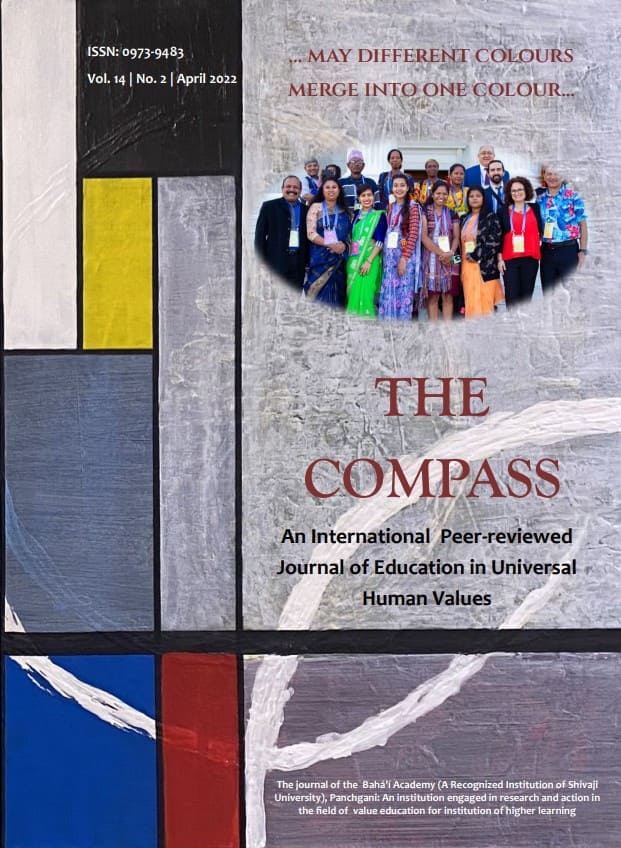
The research articles published in our last The Compass issue were well-received, and we are encouraged to publish a few more articles on the same all-important topic of education for social cohesion.
It’s a well-established fact that the first educator of a child is his/her mother. “The mother is the first teacher of the child. The message she gives that child, that child gives to the world.” — Malcolm X (Mother- A child’s first teacher - smilefoundationindia) And Abdu'l-Baha says, “…it is woman who educates man, not the reverse. She rears the children; she cares for the home upon which the body politic is founded; she gives birth to mighty leaders.” (The Great Educator of Man is Woman, 2022, http://239days.com) In other words, the foundation of social cohesion is laid in the heart and mind of the child when he/she is being nursed by his/her mother and is not considered to be developed enough to learn. Mindful parenting, hence, that nurtures in the child the qualities of inclusivity and unity should be considered as the cornerstone for education in social cohesion.
Nonetheless the above responsibility of mothers does not nullify the role of other family members. In fact, it is within the family and during the child’s upbringing that the foundation of the moral capabilities of a child is laid. The basic values and attitudes are shaped during the period that the child lives under the care of parents and is engaged in games and activities with his siblings. For instance, playing effective, collaborative and cheerful games by family members relieves ill-feelings and bitterness and indifference, and promotes fellowship, happiness and unity within the family and with others. Laughing together is yet another effective means for binding the family members and visitors together and enhance feelings of oneness. Hence every word, action or reaction that the child experiences at home, and every activity he engages in influences his thinking, personality and action; they become the standards for his future. If the child experiences a welcoming attitude towards children and people of various backgrounds, that is what he/she learns; the reverse is also true. From the above perspective in order to progress towards an inclusive society, all parents, and would be parents, should be educated about the requirements of bringing up children as promoters of social cohesion and inclusivity.
Finally, the formal education – primary, secondary, tertiary and higher education-- have the fundamental duty to nurture human values of brotherhood, justice, equality and unity – the pre-requisites of social cohesion—in the students. According to the National Education Policy 2020, “9.1.2. For the purpose of developing holistic individuals, it is essential that an identified set of skills and values will be incorporated at each stage of learning, from pre-school to higher education. 9.1.3. At the societal level, higher education must enable the development of an enlightened, socially conscious, knowledgeable, and skilled nation that can find and implement robust solutions to its own problems. Higher education must form the basis for knowledge creation and innovation thereby contributing to a growing national economy. The purpose of quality higher education is, therefore, more than the creation of greater opportunities for individual employment. It represents the key to more vibrant, socially engaged, cooperative communities and a happier, cohesive, cultured, productive, innovative, progressive, and prosperous nation.” (MHRD, 2020, Retrieved from https://www.education.gov.in/sites/upload_files/mhrd/files/NEP_Final_English_0.pdf, p. 33)
The articles in this Issue of the Compass, like the last issue, focus on education for social cohesion from the perspectives of the family, the heart of non-formal education, as well as schools and higher education institutions where formal education is offered. Unless all these entities have one voice in promoting inclusivity in every respect, it will be very difficult to move forward towards that vision.
Sincerely
Lesan Azadi (Ph.D.)
Editor
Editor-in-Chief
The Compass – An International Peer-Reviewed Journal of Education in Universal Human Values